While the terms "warehouse" and "fulfillment center" are frequently used interchangeably, the operational mechanics happening behind their loading dock doors are fundamentally different. Storing pallets of wholesale goods destined for retail distribution centers requires an entirely distinct infrastructure, workforce, and technology stack than picking, packing, and dispatching thousands of individual online consumer orders.
For growing businesses navigating supply chain expansion, choosing the wrong warehousing model leads to severe operational friction: delayed delivery times, high picking errors, excessive storage overhead, and frustrated customers.
Understanding the differences between an e-commerce warehouse and a traditional warehouse is essential for designing an efficient, scalable distribution strategy. Here is an in-depth breakdown of how both facilities function, how their operational models diverge, and how to identify which solution fits your business model.
Defining the Two Models
What Is a Traditional Warehouse?
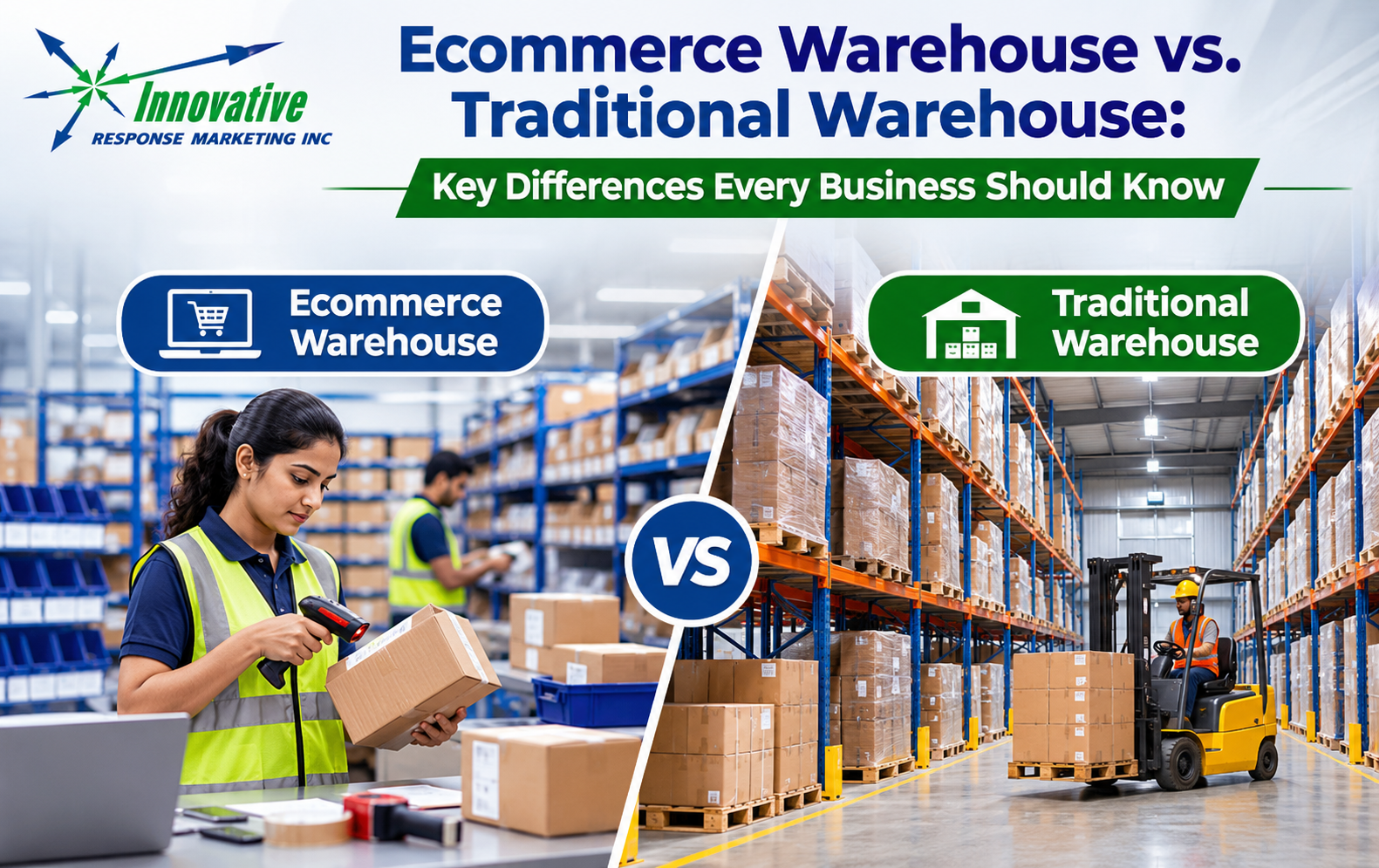
A traditional warehouse is primarily designed for business-to-business (B2B) commerce and long-term bulk storage. Its primary function is to receive large volumes of freight, securely store inventory on static industrial pallet racking, and eventually ship full pallets or master cases to brick-and-mortar retail stores, wholesalers, or corporate distribution hubs.
In a traditional facility, transactions are characterized by lower order frequencies but significantly higher product quantities per order, moving via Less-Than-Truckload (LTL) or Full-Truckload (FTL) freight.
What Is an Ecommerce Warehouse (Fulfillment Center)?
An e-commerce warehouse, often referred to as an e-commerce fulfillment center, is purpose-built for business-to-consumer (B2C) operations. Instead of holding freight static for months, an e-commerce warehouse is an active flow-through facility focused on rapid inventory turnover and individual order fulfillment.
When an individual consumer purchases an item online, warehouse specialists pick single SKUs off shelving bins, pack them into custom cartons or mailers, apply individual shipping labels, and dispatch them directly to residential doorsteps via parcel couriers.
6 Core Operational Differences Between Ecommerce and Traditional Warehouses
+———————————————————————————+
| AT A GLANCE |
| Traditional Warehouse –> Bulk In / Bulk Out –> B2B Wholesalers & Stores |
| Ecommerce Warehouse –> Bulk In / Parcel Out –> Individual Consumers (B2C)|
+———————————————————————————+
1. Order Profiles and Unit Volume
The most striking distinction lies in the composition of outbound shipments:
- Traditional Warehousing: Orders consist of high-volume, low-variety transactions. A single outbound order might consist of 10 pallets containing 500 identical master cartons of a single SKU. Warehouse staff handle orders using heavy machinery like forklifts and reach trucks rather than walking individual aisles with handheld totes.
- Ecommerce Warehousing: Orders consist of low-volume, high-variety transactions. One customer might order a single t-shirt; the next might order a coffee mug, a notebook, and a pair of socks. Staff must locate diverse items across distinct picking zones, bring them together into a single package, and verify accuracy before sealing.
2. Order Processing Speed and Fulfillment Cycles
Fulfillment velocity dictates every aspect of warehouse workflow:
- Traditional Warehousing: B2B shipments operate on predictable, scheduled distribution timelines. Purchase orders (POs) are negotiated weeks in advance, and delivery windows span days or weeks. Fast, same-day dispatch is rarely a priority; adhering to scheduled freight dock appointments is what matters.
- Ecommerce Warehousing: Speed is the defining competitive benchmark. Consumers expect orders placed in the morning to be processed, packed, and handed off to carriers by the afternoon. Fulfillment cycles are measured in hours, not days. Any internal delay directly threatens customer retention and online reviews.
3. Facility Layout and Space Optimization
The physical architecture of each facility reflects its operational priorities:
- Traditional Warehousing: Prioritizes vertical cubic storage density. Aisles are wide enough to accommodate heavy forklifts, and industrial racking extends high toward the ceiling to maximize pallet positions. Floor space dedicated to packing stations or manual handling is minimal.
- Ecommerce Warehousing: Prioritizes accessible floor-level picking paths and sorting efficiency. Facilities feature wide arrays of low-level bin shelving, gravity-fed flow racks, dynamic pick modules, multi-tier mezzanines, and extensive packing workstations equipped with automated tape dispensers, barcode scanners, and void-fill hoppers.
4. Technology Stack and Platform Integrations
Both models require software, but their technical architectures serve entirely different operational demands:
- Traditional Warehousing: Relies on enterprise-level Enterprise Resource Planning (ERP) software and Electronic Data Interchange (EDI) systems. The software tracks bulk lot numbers, expiration dates, pallet locations, and advance shipping notices (ASNs) coordinated with freight logistics networks.
- Ecommerce Warehousing: Requires dynamic Warehouse Management Systems (WMS) that integrate via live APIs directly into online storefronts and multi-channel marketplaces (such as Shopify, WooCommerce, Amazon, and eBay). The WMS must sync stock levels instantly to prevent overselling, optimize picking routes via algorithmic batching, generate real-time parcel carrier tracking numbers, and send automated delivery updates to buyers.
5. Reverse Logistics and Returns Processing
How a warehouse handles returns highlights another major contrast:
- Traditional Warehousing: B2B returns are infrequent. When they occur, they typically involve damaged pallets, incorrect freight shipments, or seasonal inventory recalls that are logged and managed in bulk.
- Ecommerce Warehousing: Returns are a massive, daily operational reality. E-commerce return rates typically range from 20% to 30%, especially in categories like apparel and footwear. An e-commerce fulfillment center must maintain a dedicated reverse logistics workflow to receive individual parcels, inspect goods for wear, re-tag, re-bag, re-box, and return sellable items to active inventory without causing operational bottlenecks.
6. Packaging, Kitting, and Value-Added Services
Outbound packaging requirements differ dramatically between wholesale and direct-to-consumer:
- Traditional Warehousing: Packaging is purely functional and utilitarian. Items are secured on standardized wooden pallets, wrapped in industrial stretch film, strapped with plastic banding, and labeled with standard GS1-128 freight barcodes.
- Ecommerce Warehousing: Packaging serves as a primary brand touchpoint. E-commerce facilities regularly execute custom kitting, assembly of subscription boxes, gift messaging, branded tissue wrapping, and the insertion of personalized promotional materials or direct mail print inserts.
Comparison Matrix: Ecommerce Warehouse vs. Traditional Warehouse
|
Operational Metric |
Traditional Warehouse |
Ecommerce Warehouse |
|---|---|---|
|
Primary Audience |
B2B (Retailers, distributors, wholesalers) |
B2C (Direct-to-consumer online buyers) |
|
Outbound Unit Sizes |
Full pallets, gaylords, master cartons |
Individual items, parcel mailers, small boxes |
|
Fulfillment Velocity |
Scheduled over days/weeks |
Same-day or next-day turnaround (hours) |
|
Inbound/Outbound Transport |
Freight (FTL / LTL carriers, rail, intermodal) |
Parcel couriers (Canada Post, FedEx, UPS, regional couriers) |
|
Inventory Turnover |
Low to moderate velocity; long-term storage |
High velocity; rapid stock movement |
|
Picking Methodology |
Pallet/case picking via forklift |
Piece picking (batch, zone, wave picking) |
|
Return Handling |
Minimal, planned bulk returns |
Continuous, high-volume reverse logistics |
|
Value-Added Packaging |
Industrial stretch wrap, banding, freight labels |
Custom boxes, branded tissue, unboxing collateral, kitting |
The Omnichannel Reality: Bridging the Gap
For many modern brands, distribution is no longer strictly B2B or B2C, rather it is omnichannel. A company may sell direct to consumers through an online shop while simultaneously supplying nationwide retail chains, boutique stockists, and corporate clients.
Attempting to run both models through a purely traditional warehouse results in sluggish e-commerce shipping speeds and high picking errors. Conversely, attempting to manage bulk freight through a small-parcel-only operation leads to space shortages and logistical inefficiencies.
To solve this, leading businesses partner with versatile Third-Party Logistics (3PL) providers that possess the infrastructure to execute hybrid fulfillment. An agile 3PL seamlessly handles palletized freight and Point of Sale (POS) retail store fulfillment on one side of the facility, while running high-speed, automated pick-and-pack parcel operations on the other.
The Strategic Advantage of Location in Canada
For Canadian businesses, geographic placement is just as critical as warehouse type. Operating an e-commerce or hybrid warehouse within a primary logistics gateway such as Mississauga and the Greater Toronto Area (GTA) delivers unmatched competitive advantages:
- Superior Transit Connectivity: Proximity to major arterial highway corridors (Highways 401, 403, 407, and 427) ensures ground couriers and freight haulers move inbound and outbound inventory without transit bottlenecks.
- Postal & Freight Hub Integration: Direct access to major Canada Post distribution sorting plants and international cargo terminals at Toronto Pearson International Airport accelerates final-mile delivery.
- Broad Consumer Reach: Placing fulfillment operations in the GTA positions your inventory within hours of Canada’s densest consumer population, reducing shipping zones and lowering parcel postage rates.
Unify Your Warehousing and Fulfillment with Innovative Response Marketing
Whether your business requires dedicated e-commerce pick-and-pack services, commercial bulk warehousing, or retail point-of-sale distribution, you need an operational partner equipped to handle your entire supply chain under one roof.
At Innovative Response Marketing Inc., based in Mississauga, Ontario, we bridge the gap between traditional warehousing reliability and modern e-commerce speed. With more than 20 years of industry experience, our facilities provide comprehensive 3PL solutions, including:
- E-Commerce & B2C Fulfillment: High-accuracy pick, pack, and ship workflows integrated seamlessly with your digital shopping cart platforms.
- Commercial Warehousing & Distribution: Secure, scalable storage for bulk inventory, master cases, and scheduled freight distribution.
- POS, POP & Promotional Fulfillment: Specialized kitting and distribution of point-of-sale retail displays and promotional kits.
- Canada Post Smartmail & Variable Print Integration: In-house variable and offset printing capabilities combined with certified Canada Post Smartmail Expert Partner status to integrate direct mail and branded collateral directly into your distribution strategy.
Our advanced warehouse management systems offer seamless EDI and marketplace integration, providing you with 24/7 portal access to track stock levels, orders, and delivery progress in real time.
Ready to optimize your fulfillment strategy and scale your operations? Contact Innovative Response Marketing Inc. today to request a quote and discover how our tailored warehousing and fulfillment solutions can drive your business forward.